
Micro vs Macro Influencers: Which Is Better for Your Business?
Influencer marketing has become one of the most effective ways to promote products and services online. But one common question brands face is: should you work with micro influencers or macro influencers?
Choosing the right type of influencer can significantly impact your campaign results. In this guide, we’ll break down the differences between micro and macro influencers, their pros and cons, and help you decide which is best for your business.
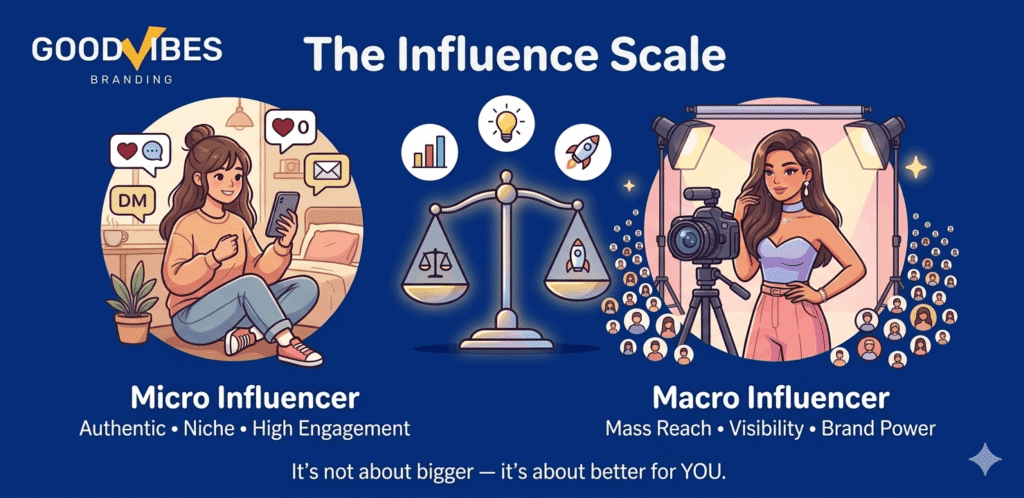
What Are Micro Influencers?
Micro influencers are content creators who typically have 1,000 to 100,000 followers on social media platforms.
They are known for having a highly engaged and niche audience, which makes them ideal for targeted marketing.
Key Characteristics of Micro Influencers
- Smaller but loyal audience
Their followers trust their recommendations, leading to better engagement. - Niche-focused content
They usually specialize in specific areas like fitness, fashion, food, or tech. - Higher engagement rates
Their audience interacts more through likes, comments, and shares. - More affordable collaborations
Brands can work with multiple micro influencers within a limited budget.
What Are Macro Influencers?
Macro influencers are individuals with 100,000 to 1 million+ followers.
They are often well-known personalities or established creators with a large reach.
Key Characteristics of Macro Influencers
- Large audience reach
They can expose your brand to a wide audience quickly. - Strong brand recognition
Their popularity can enhance your brand’s credibility. - Professional content creation
Their posts are usually high-quality and polished. - Higher collaboration costs
Campaigns with macro influencers require a bigger budget.
Micro vs Macro Influencers: Key Differences
Factor | Micro Influencers | Macro Influencers |
Followers | 1K – 100K | 100K – 1M+ |
Engagement | High | Moderate |
Cost | Affordable | Expensive |
Reach | Limited | Very high |
Audience Trust | Strong | Moderate |
Micro vs Macro Influencers: Pros and Cons Comparison
Factor | Micro Influencers | Macro Influencers |
Engagement | High engagement due to strong audience connection (Pro) | Lower engagement compared to micro influencers (Con) |
Reach | Limited reach due to smaller audience (Con) | Massive reach helps increase brand visibility (Pro) |
Cost | Affordable and budget-friendly (Pro) | Expensive and requires higher investment (Con) |
Targeting | Highly niche and targeted audience (Pro) | Broader audience, may not always be targeted (Con) |
Trust & Authenticity | High trust and authenticity with followers (Pro) | Less personal connection with audience (Con) |
Content Quality | May vary depending on influencer (Con) | High-quality and professional content (Pro) |
Campaign Speed | Slower results due to smaller reach (Con) | Faster results and instant visibility (Pro) |
ROI | Better conversions due to trust (Pro) | ROI can vary despite high reach (Con) |
Scalability | Requires multiple influencers to scale (Con) | Easy to scale campaigns with one influencer (Pro) |
Brand Awareness | Lower awareness compared to macro influencers (Con) | Strong brand awareness and recognition (Pro) |
Which Is Better for Your Business?
The answer depends on your business goals, budget, and target audience.
Choose Micro Influencers if:
- You want higher engagement and conversions
- You have a limited budget
- You are targeting a specific niche audience
- You want authentic brand promotion
Choose Macro Influencers if:
- You want maximum brand visibility
- You are launching a new product or campaign
- You have a larger marketing budget
- You want quick reach and awareness
Best Strategy: Combine Both
Many successful brands use a hybrid influencer marketing strategy.
- Use macro influencers for reach and brand awareness
- Use micro influencers for engagement and conversions
This approach helps you get the best of both worlds.
Why Choose Good Vibes Branding for Influencer Marketing?
Choosing the right influencers is only half the battle. Executing a successful campaign requires strategy, planning, and expertise.
At Good Vibes Branding, we help businesses create result-driven influencer marketing campaigns that deliver real growth.
What We Offer
- Customized influencer strategies
We match your brand with the right influencers based on your goals and audience. - Access to trusted influencers
We collaborate with verified creators across different niches. - Budget-friendly campaigns
Our solutions are designed to maximize ROI for small and growing businesses. - End-to-end campaign management
From planning to execution, we handle everything for you. - Performance tracking and insights
We measure campaign success to ensure continuous improvement.
Whether you want to work with micro influencers, macro influencers, or both, our team ensures your campaign delivers measurable results.
Final Thoughts
Both micro and macro influencers offer unique advantages. The key is to align your choice with your business objectives.
- Micro influencers are best for engagement and conversions
- Macro influencers are best for reach and brand awareness
For most businesses, a balanced strategy works best.
If you’re looking to grow your brand through influencer marketing, partnering with experts like Good Vibes Branding and Hospitalityminds can help you achieve better results with the right strategy.
FAQs
What is the difference between micro and macro influencers?
Micro influencers have smaller, highly engaged audiences, while macro influencers have larger audiences with wider reach.
Are micro influencers better than macro influencers?
Micro influencers are better for engagement and niche targeting, while macro influencers are better for visibility and brand awareness.
Which influencer type is best for small businesses?
Micro influencers are usually more suitable for small businesses due to affordability and higher engagement rates.
Latest Post
-
Micro vs Macro Influencers: Which Is Better for Your Business?
-
 SEO for Small Business: How It Helps Your Business Grow Online
 -
 Why Choose a Real Estate Digital Marketing Agency in Mumbai for Faster Property Sales?example
 -
 How to Choose the Right Influencer Marketing Agency in Mumbai
 -
 AI in Healthcare Digital Marketing Services: How Healthcare Providers Can Stay Ahead
 -
 How to Choose the Right SEO Outsourcing Partner in Mumbai
 -
 How a Digital Marketing Agency in Mumbai Scaled Sensory Bins India with SEO & PPC
 -
 How a Digital Marketing Agency in Mumbai Drove Sustainable Organic Growth for Tatvm Group