
15 Google Business Profile Optimizations Every Local Business Should Be Making in 2026
For a long time, business owners treated Google Business Profile as a “set it and forget it” listing — claim it, add a phone number, done. In 2026, that mindset is costing businesses real customers.
Google Business Profile has quietly become one of the most competitive pieces of local real estate a business owns, directly shaping who shows up in Google Maps, the Local Pack, and increasingly, AI-generated local recommendations. A half-finished profile isn’t just missing polish — it’s actively losing ground to competitors who treat theirs as a full-time asset.
In this guide, we’ll break down the 15 optimizations local businesses should be making to their Google Business Profile right now.
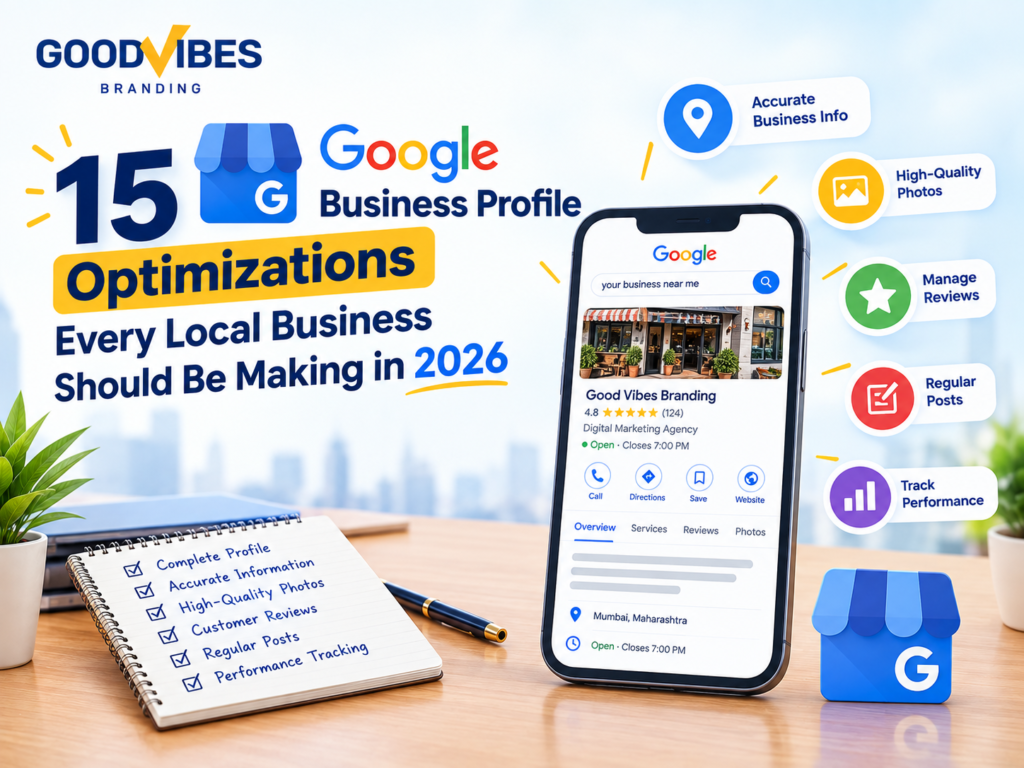
Why Google Business Profile Is Becoming Impossible to Ignore
Local search behavior has shifted meaningfully over the past few years:
- The Local Pack and Maps results often appear before any organic listing for “near me” and location-based searches.
- Google increasingly pulls Business Profile data directly into AI Overviews when answering local queries.
- Customers now expect to find hours, reviews, photos, and even direct messaging without ever visiting a website.
- A weak or inconsistent profile can quietly disqualify a business from local recommendations altogether, regardless of how strong the website is.
For local businesses in Mumbai and beyond, Google Business Profile isn’t a supporting asset anymore — it’s often the first, and sometimes only, impression a customer gets.
1. Claim and Fully Verify Your Profile
An unclaimed or unverified profile is the single biggest visibility gap a local business can have. This means confirming ownership through Google’s verification process and ensuring no duplicate, unclaimed listings exist for the same location. An unverified profile simply won’t compete for local rankings.
2. Choose the Most Accurate Primary and Secondary Categories
Category selection directly shapes which searches your profile is eligible to appear for. This means choosing the single most accurate primary category, then layering in relevant secondary categories that reflect your full range of services. Getting this wrong quietly excludes you from searches you should be winning.
3. Write a Keyword-Rich, Honest Business Description
Your business description should read naturally while still working in the terms customers actually search — like “Digital Marketing Agency in Mumbai” or “SEO Services Mumbai.” This means describing what you do, who you serve, and where, without keyword-stuffing. A clear description helps both customers and Google understand your relevance.
4. Keep NAP (Name, Address, Phone) Consistent Everywhere
Inconsistent business details across your website, directories, and your Business Profile actively undermine local trust signals. This means auditing your name, address, and phone number for exact consistency across every platform where your business appears. Even small formatting mismatches can dilute your local authority.
5. Add and Update Business Hours (Including Holidays)
Nothing erodes customer trust faster than showing up to a business that’s listed as open but isn’t. This means keeping standard hours accurate and proactively updating holiday or special hours ahead of time. Google also increasingly favors profiles that stay actively maintained.
6. Upload High-Quality, Geo-Tagged Photos Regularly
Photos are one of the most-viewed elements of a Business Profile, and stale or generic images cost you real engagement. This means regularly uploading high-resolution, geo-tagged photos of your storefront, team, products, and work in progress. Profiles with fresh photos consistently outperform those with a handful of outdated ones.
7. Use the Products/Services Section to List Offerings in Detail
Many businesses leave this section empty, missing an easy opportunity to be matched against specific searches. This means listing individual services or products with clear names, descriptions, and pricing where relevant. A detailed offerings section helps Google match you to more precise, higher-intent queries.
8. Enable and Respond to Messaging Promptly
Customers increasingly expect to message a business directly from its profile before ever calling or visiting. This means enabling messaging and treating response time as seriously as you would a phone enquiry. Slow or ignored messages don’t just lose the customer — they can quietly affect your profile’s performance.
9. Post Regular Updates (Google Posts)
Google Posts let you share offers, events, and updates directly on your profile, but most businesses never use them. This means posting consistently — new offers, seasonal updates, or announcements — rather than leaving the feature dormant. Regular posting signals an active, trustworthy business to both customers and Google.
10. Collect and Respond to Every Review
Reviews remain one of the strongest local ranking and trust signals available, and unanswered reviews leave value on the table. This means actively requesting reviews from satisfied customers and responding — thoughtfully — to every review, positive or negative. A business that visibly engages with feedback reads as far more credible than one that doesn’t.
11. Add Attributes That Match Customer Search Behavior
Attributes like “women-led,” “wheelchair accessible,” or “online appointments” help your profile surface in filtered and refined searches. This means reviewing the full attribute list Google offers for your category and enabling every one that genuinely applies. Skipping this step means losing visibility in searches built around exactly these filters.
12. Use the Q&A Section Proactively
Left unmanaged, the Q&A section often fills with unanswered or even incorrect customer-submitted questions. This means seeding it with the questions customers actually ask, answering promptly, and correcting any inaccurate public answers. A well-maintained Q&A section builds trust before a customer even reaches your website.
13. Track Insights and Adjust Based on Data
Google Business Profile provides direct data on how customers are finding and interacting with your listing, and most businesses never look at it. This means regularly reviewing search queries, views, and action clicks to understand what’s working. That data should directly inform which categories, services, and posts you prioritize next.
14. Optimize for Voice and AI-Driven Local Search
Local queries increasingly arrive as spoken or conversational questions — “who’s open near me right now” — rather than typed keywords. This means writing your description, posts, and Q&A answers in natural, conversational language that mirrors how customers actually ask. Profiles structured this way are better positioned to be pulled into AI-generated local recommendations.
15. Maintain Multi-Location Consistency (If Applicable)
For businesses with more than one location, inconsistency between profiles actively works against local rankings for every location involved. This means standardizing category selection, description tone, and update cadence across all locations, while still customizing details like hours and local offers. A disciplined multi-location strategy strengthens every individual profile rather than competing against itself.
What This Means for Businesses Going Forward
Google Business Profile in 2026 rewards businesses that treat it as a living asset, not a static listing. The businesses winning local visibility are the ones combining complete, accurate details with consistent activity — photos, posts, reviews, and responses — month after month.
Why Choose Goodvibes Branding
At Goodvibes Branding, we believe local visibility in 2026 means showing up accurately and consistently everywhere a customer might look, not just ranking once and moving on. That belief shapes how we manage Google Business Profile for every local client we work with.
Our SEO team handles profile optimization, category strategy, and the technical consistency that keeps your listing competitive, while our Content Marketing team keeps your posts, descriptions, and Q&A fresh and genuinely useful to customers. Together, they turn a static listing into an active local growth channel.
As a leading Digital Marketing Agency in Mumbai, we stay ahead of exactly this kind of shift so our clients don’t have to.
Contact us today to discover how our data-driven marketing solutions can help your business generate more qualified local enquiries.
Latest Post
-
 Topical Authority in SEO: How to Build a Content Cluster That Actually Ranks (2026 Guide)
 -
15 Google Business Profile Optimizations Every Local Business Should Be Making in 2026
-
 How to Get Your Business Mentioned in ChatGPT, Gemini, and Google AI Overviews (2026 Guide)
 -
 GEO vs. SEO: What's the Difference, and Do Businesses Need Both in 2026?
 -
 How AI Search Is Changing the Way Customers Discover Brands
 -
 Brand Photography vs Stock Images: Why Authentic Visuals Win in 2026
 -
 Real Estate Digital Marketing in Mumbai: How Builders Are Generating Qualified Leads
 -
 How Restaurants & Hospitality Brands Can Win Local Customers Through Digital Marketing