
Topical Authority in SEO: How to Build a Content Cluster That Actually Ranks (2026 Guide)
For years, the standard SEO advice was simple: pick a keyword, write a page, publish, repeat. In 2026, that approach is running out of road.
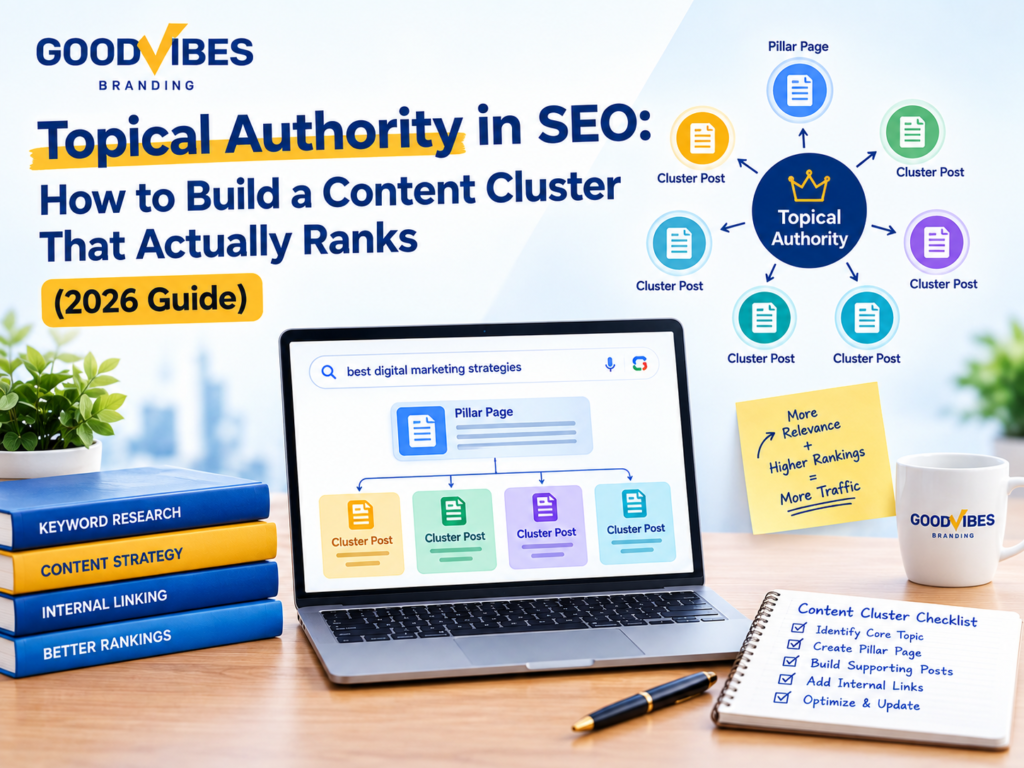
Google’s algorithms — and increasingly, the AI models summarizing search results — no longer reward isolated pages competing on keyword density alone. They reward businesses that demonstrate genuine depth on a subject, across dozens of interconnected pages that clearly belong together. That’s topical authority, and it’s built through content clusters, not standalone posts.
In this guide, we’ll break down what topical authority actually means and the concrete steps to building a content cluster that ranks — and keeps ranking.
Why Topical Authority Is Becoming Impossible to Ignore
A handful of shifts have made isolated, one-off content noticeably weaker than it used to be:
- Search engines increasingly evaluate a site’s overall depth on a subject, not just the strength of a single page.
- AI Overviews and AI search tools favor sources that clearly cover a topic comprehensively, since that reduces the risk of citing an incomplete answer.
- Businesses publishing scattered, unrelated content dilute their relevance instead of building it, no matter how many pages they add.
- A well-structured cluster compounds in value over time, while isolated posts tend to plateau and fade.
The takeaway is straightforward: ranking in 2026 is less about how many pages you have, and more about how clearly they prove you understand the subject.
1. Start With a Pillar Topic, Not a Pillar Page
A content cluster begins with choosing a broad, commercially relevant subject your business can genuinely speak to in depth — not just a single page you’d like to rank. This means selecting a pillar topic wide enough to support 8–15 supporting pages, but narrow enough to stay genuinely relevant to your services. Get the pillar topic right, and the entire cluster around it becomes far easier to plan.
2. Map the Subtopics Your Audience Actually Searches
Once the pillar topic is set, the next step is identifying the specific questions and subtopics customers search around it. This means researching real search queries, “people also ask” patterns, and the follow-up questions customers raise in calls or reviews, then grouping them into logical subtopics. A cluster built on real search behavior will always outperform one built on guesswork.
3. Structure a Hub-and-Spoke Internal Linking Model
Topical authority isn’t just about having related content — it’s about proving those pages are connected. This means building one central “hub” page that overviews the pillar topic, with each subtopic “spoke” page linking back to the hub and to relevant sibling spokes. This internal linking structure is what actually signals depth to search engines, not just the existence of the pages themselves.
4. Go Deeper Than Competitors on Each Spoke
A cluster full of shallow, surface-level pages won’t outrank competitors who’ve genuinely covered the subject. This means auditing what’s currently ranking for each subtopic and deliberately going further — more specific examples, clearer data, more practical detail. Depth, not length for its own sake, is what separates a page that ranks from one that doesn’t.
5. Match Content Depth to Search Intent, Not Word Count
Not every spoke page needs to be exhaustive; some queries genuinely call for a short, direct answer. This means matching each page’s length and format to what the searcher actually needs — a quick definition, a comparison table, or a full walkthrough — rather than padding every page to hit an arbitrary word count. Intent-matched content consistently earns better engagement than uniformly long content.
6. Maintain and Expand the Cluster Over Time
A content cluster isn’t a one-time project — clusters that stop growing eventually lose ground to competitors who keep building. This means revisiting existing spokes for freshness, adding new spokes as new questions emerge, and periodically updating the hub page to reflect the cluster’s growth. Treating the cluster as a living asset is what sustains rankings well beyond the initial publish.
What This Means for Businesses Going Forward
Building topical authority isn’t about publishing more content — it’s about publishing content that visibly belongs together, answers real questions in depth, and keeps expanding over time. Businesses that plan clusters deliberately, rather than accumulating pages ad hoc, are the ones building rankings that actually compound.
Why Choose Goodvibes Branding
At Goodvibes Branding, we believe ranking in 2026 comes from genuine depth, not scattered content chasing individual keywords. That belief shapes how we plan every content strategy we build for clients.
Our Content Marketing team maps and writes content clusters designed around real search behavior and clear internal linking, while our SEO team ensures the technical structure and site architecture actually support that depth in the eyes of search engines. Together, they turn a collection of pages into a genuine topical authority.
As a leading Digital Marketing Agency in Mumbai, we stay ahead of exactly this kind of shift so our clients don’t have to.
Contact us today to discover how our data-driven marketing solutions can help your business build content that actually ranks — and keeps ranking.
Latest Post
-
Topical Authority in SEO: How to Build a Content Cluster That Actually Ranks (2026 Guide)
-
 15 Google Business Profile Optimizations Every Local Business Should Be Making in 2026
 -
 How to Get Your Business Mentioned in ChatGPT, Gemini, and Google AI Overviews (2026 Guide)
 -
 GEO vs. SEO: What's the Difference, and Do Businesses Need Both in 2026?
 -
 How AI Search Is Changing the Way Customers Discover Brands
 -
 Brand Photography vs Stock Images: Why Authentic Visuals Win in 2026
 -
 Real Estate Digital Marketing in Mumbai: How Builders Are Generating Qualified Leads
 -
 How Restaurants & Hospitality Brands Can Win Local Customers Through Digital Marketing