
Meta Ads vs Google Ads for Property Launches in Mumbai: Which Should Developers Use?
Every developer planning a project launch in Mumbai eventually faces the same budget debate: should the money go to Google or to Meta? For years, the usual answer was “Meta for volume, Google for quality”, and then a split decided by gut feel.
In 2026, that shortcut costs real money. Buyers now research through Google, Instagram, YouTube and AI tools like ChatGPT and Gemini before they ever call a sales team, so each platform plays a different role at a different stage of a launch.
In this guide, we’ll compare Meta ads and Google ads for Mumbai property launches on intent, lead quality, cost per lead and site-visit rate, then suggest a budget split for pre-launch and launch.
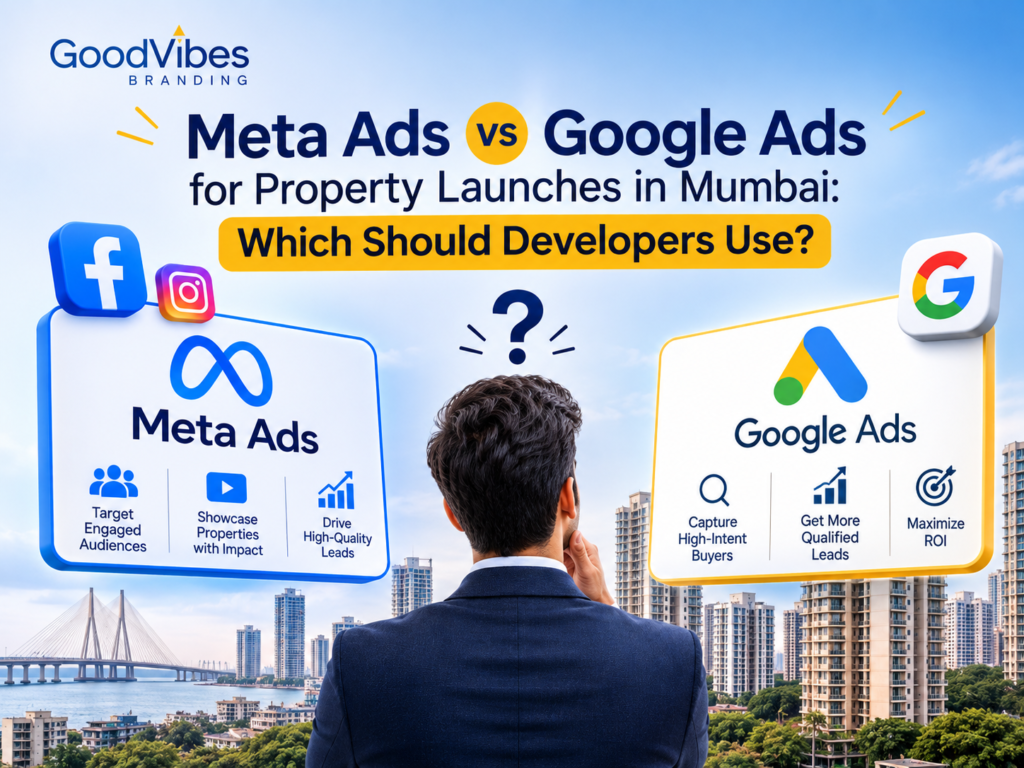
Understanding the Difference
How Meta Ads Reach Property Buyers
Meta (Facebook and Instagram) shows your project to people based on who they are: their location, income, age and interests. The buyer wasn’t looking for a home, so the ad creates the interest. That makes Meta strong for awareness and volume, and weaker on intent.
How Google Ads Reach Property Buyers
Google Search shows your project to people based on what they type, such as “2 BHK Powai under 2 crore”. The buyer is already searching, so the ad meets existing demand. That makes Google more expensive per click, but far closer to a decision.
Factor | Meta ads | Google ads |
Buyer intent | Low to medium | High |
Lead volume | High | Medium |
Lead quality | Mixed, needs qualifying | Stronger, fewer time-wasters |
Indicative cost per lead (₹) | 600–1,200 | 800–2,500 |
Lead-to-site-visit rate | Lower | Higher |
Best phase | Pre-launch and launch awareness | Launch and ongoing sales |
These costs are approximate India-wide benchmarks, and Mumbai usually sits at the upper end depending on the micro-market and ticket size.
The takeaway: Meta creates demand, Google captures it, and a launch needs both at different moments.
When Meta Ads Deliver Better Results
1. Building Awareness Before Anyone Is Searching
Before a launch, almost nobody is searching for your project by name. Meta lets you reach the right households in the right micro-markets early, so demand exists by the time Google searches begin.
2. Showing the Project Visually
Property is a visual purchase. Reels, carousels and walkthrough videos on Instagram and Facebook let buyers picture the lifestyle, which a text ad on Google can’t do.
3. Generating Volume Quickly
When you need a large pool of enquiries fast, such as at a launch weekend, instant lead forms and click-to-WhatsApp ads produce volume at a lower cost per lead than search.
4. Retargeting Warm Buyers
People who watched your video, visited your site or opened a brochure can be retargeted across Instagram and Facebook until they book a visit.
When Google Ads Deliver Better Results
1. Capturing Buyers Who Are Ready Now
Someone searching “ready possession 3 BHK Thane” has a budget, a location and a timeline. Google puts your project in front of them at that exact moment.
2. Filtering Out Casual Enquiries
Because buyers type specific searches, Google leads tend to be better qualified. Your sales team spends less time on people who were only curious.
3. Protecting Your Brand Name
Once your launch gets attention, competitors and portals bid on your project name. Branded search ads make sure buyers reach you, not a rival.
4. Scaling What Already Converts
Search campaigns give clear data on which localities, configurations and keywords produce site visits, so you can shift budget with confidence.
The Metric Developers Often Ignore
Most launch reports compare Meta and Google on cost per lead, and Meta usually wins that contest. The number that matters more is cost per site visit, and ultimately cost per booking.
A ₹700 Meta lead that never answers the phone costs more than a ₹1,800 Google lead who visits the site and books. Developers who track leads only at the form stage tend to over-invest in the channel that looks cheapest and under-invest in the one that closes.
The Impact of AI on Property Ad Campaigns in 2026
Buyers now ask ChatGPT, Gemini and Google AI Overviews questions like “best upcoming projects in Chembur” before clicking any ad. AI-assisted Google campaigns also automate more bidding and targeting than before.
This makes accurate project pages, consistent information and strong first-party data more valuable than ever, because both platforms’ algorithms learn from the quality of leads you feed back to them.
So... How Should Developers Split the Budget?
The right split depends on the phase of the launch. Use this as a starting point, then adjust once you see cost per site visit by channel.
Phase | Meta ads | Google ads | Retargeting and YouTube |
Pre-launch (4–6 weeks before) | 60–70% | 20–25% | 10–15% |
Launch (first 4–8 weeks) | 40–45% | 40–45% | 10–15% |
These ratios are a suggested starting framework, not a fixed rule, and they should shift as your data shows which channel produces site visits.
Lean towards Meta if you:
- Are creating awareness for a project nobody knows yet
- Have strong visuals, walkthroughs and a clear launch offer
- Need volume to fill an event or launch weekend
Lean towards Google if you:
- Are selling ready or near-ready inventory
- Have a tight sales team that wants fewer, better leads
- Already have brand awareness to capture
The best strategy? Use both in sequence: Meta to build demand before launch, Google to capture it once buyers start searching, and WhatsApp follow-up within minutes to convert both.
Learn how this fits into a wider plan in our guide to real estate lead generation channels in Mumbai.
Why Choose Goodvibes Branding
At Goodvibes Branding, we believe a property launch in 2026 is won by sequencing the right platforms, not by picking a favourite one. Meta builds the demand, Google captures it, and both should be judged by site visits and bookings.
Our Google Ads agency team builds search campaigns around high-intent buyer queries and branded protection, while our real estate marketing specialists plan the full launch mix, from pre-launch Meta creative to tracked, WhatsApp-ready follow-up.
As a leading Digital Marketing Agency in Mumbai, we stay ahead of how buyers search and how platforms change, so our clients don’t have to.
Contact us today to discover how our data-driven marketing solutions can help your next launch generate more qualified site visits.
Latest Post
-
Meta Ads vs Google Ads for Property Launches in Mumbai: Which Should Developers Use?
-
 Real Estate Lead Generation in Mumbai: 7 Channels That Bring Serious Buyers (2026)
-
 WhatsApp Marketing for Small Businesses: Campaigns That Get Replies in 2026
-
 Post-Diwali Marketing: How Mumbai Brands Keep Festive Customers Coming Back
-
 Topical Authority in SEO: How to Build a Content Cluster That Actually Ranks (2026 Guide)
-
 15 Google Business Profile Optimizations Every Local Business Should Be Making in 2026
-
 How to Get Your Business Mentioned in ChatGPT, Gemini, and Google AI Overviews (2026 Guide)
-
 GEO vs. SEO: What's the Difference, and Do Businesses Need Both in 2026?